A 120-Meter Buddha and a Sordid Power Struggle—Thoughts from a Visit to Ushiku Daibutsu
The other day, my wife and I visited Ushiku Daibutsu in Ibaraki Prefecture.
It stands 120 meters tall. It is enormous by any measure.
However, the statue was completed in 1992. Rather than a historic Buddhist statue, it is a colossal modern structure.
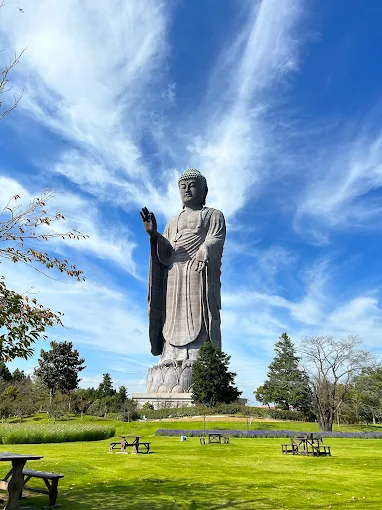
To be honest, my first thought was, “If size is all it has to offer, how is it any different from a skyscraper?”
Once I actually visited, however, I made some unexpectedly interesting discoveries.
Were Half the Visitors from Overseas?
The first surprise was the sheer number of international visitors.
My impression was that they accounted for about half of everyone there.
The mix also seemed somewhat different from the international tourists I see in Kyoto or Asakusa.
I saw very few people who appeared to be Western. Visitors who looked Southeast Asian were much more noticeable, along with people who appeared to be from China or South Korea.
Of course, you cannot determine someone’s nationality from appearance alone. At the very least, however, the overwhelming majority of international visitors appeared to be Asian.
When you think about it, Buddhism is not a religion unique to Japan.
Buddhist culture has deep roots in Southeast Asia, China, and South Korea as well. Just as Japanese people travel abroad to see famous Buddhist statues, an enormous Buddha must be an attraction for them too.
Unlike the temples and shrines of Kyoto, the scene gave me a sense of a culture shared across Asia.
If There Is an Eastern Honganji, There Must Be a Western One
Another interesting discovery was the history of the Buddhist school described at the temple grounds.
Ushiku Daibutsu was built by Jodo Shinshu Higashihonganji-ha, a branch of Jodo Shinshu Buddhism.
If there is a “Higashi Honganji,” or Eastern Honganji, does that mean there is also a “Nishi Honganji,” or Western Honganji?
There is.
Moreover, the eastern and western branches split about 400 years ago. One of the triggers was a family conflict involving a father, his sons, and the relationship between the brothers.
During Japan’s Warring States period, Honganji was a vast religious organization with its own military power.
It is said that the political authorities, seeking to weaken that power, intervened in the brothers’ succession dispute and granted them separate tracts of land.
This was the origin of Higashi Honganji and Nishi Honganji.
It was not simply a split caused by a difference in Buddhist doctrine.
In short, it was a struggle for control of a religious organization.
Four Hundred Years Later, the Power Struggle Was Still Not Over
Surprisingly, Higashi Honganji itself underwent another major internal conflict in the decades from the 1960s through the 1980s.
For many years, the Otani family had inherited the leading position at Higashi Honganji.
After World War II, however, a movement grew to separate the administration of the religious organization from the authority of one particular family.
Those who wanted to preserve the traditional powers of the head priest resisted.
The conflict became known as the “Ohigashi Dispute” (“Eastern Conflict”) and continued for many years.
As a result, people who broke away from Higashi Honganji in Kyoto formed separate Buddhist schools. One of them was Jodo Shinshu Higashihonganji-ha, the school that built Ushiku Daibutsu.
Since this group is based in Tokyo, I will refer to it here, for convenience, as Tokyo’s Higashi Honganji.
The organization split into eastern and western branches 400 years ago, and then, between the 1960s and the 1980s, the eastern branch split again internally.
It is a remarkably busy religion.
Do Japanese People Like the Authority of Bloodlines?
Learning this story reminded me of Japan’s imperial system.
In Japan, the power to conduct actual politics and the authority inherited through bloodlines have long existed separately.
Even after the Emperor ceased to wield real political power, the institution of the Emperor itself remained.
I sense a similar structure in the Higashi Honganji dispute.
The religious organization can be administered institutionally. Yet the question remains of how to position the authority of the Otani family, with its long history.
Even today, at Higashi Honganji in Kyoto, a Monshu (the spiritual head of the Buddhist school) from the Otani lineage serves as a religious symbol.
Political or administrative power was relinquished, while authority based on bloodline remained. It seems that even the Kyoto side, for all its reformist ambitions, could not reform the role of bloodline itself.
It strikes me as a very Japanese arrangement.
“That Is a Pretty Sordid Story for Buddhist Monks”
On the way home, I told my wife about this history. She was driving, so I had looked it up on Wikipedia while we were on the road.
She responded with a single exasperated remark.
“That is a pretty sordid story for Buddhist monks…”
She was absolutely right.
Buddhism is a religion that teaches people to free themselves from worldly desires and attachments.
Yet the religious organizations meant to spread those teachings have spent centuries fighting over power and position.
Brothers were at odds 400 years ago, and the organization split yet again between the 1960s and the 1980s.
It is not so different from a company or a political party.
Ushiku Daibutsu, seemingly unconcerned by such human affairs, quietly looked down on the world from its height of 120 meters.
Apparently, even the power of the Buddha cannot put an end to human power struggles.