Japan's “Solutions” Strategy for Physical AI Reminds Me of a Chinese Robot We Mocked 30 Years Ago
I recently watched an NHK program about physical AI.
Generative AI is no longer limited to writing text or creating images. It is now being combined with robots and beginning to operate in the physical world—in factories, logistics, nursing care, construction, and other fields. This is what people call physical AI.
I found it fascinating to see how far the technology had come. But the program also painted a fairly harsh picture of Japan’s position.
When it comes to the hardware—the “body” of a robot—Chinese companies are advancing with overwhelming cost competitiveness and development speed.
Meanwhile, American companies dominate the “brain”: semiconductors, AI models, and foundational software.
To put it very crudely:
The body comes from China. The brain comes from the United States. So what is left for Japan to do?
Put that way, it is difficult not to feel that Japan has already lost.
Japan Will Compete Through Solutions
The program’s answer was that Japan should not try to compete head-on in foundational technology. Instead, it should compete through “solutions”—adapting AI and robots so that they actually work in real-world environments.
A factory needs one solution. A logistics center needs another. Nursing care has its own requirements.
Japanese companies could use their traditional strengths in continuous workplace improvement and attention to detailed customer needs, turning foreign-made AI and robots into systems that genuinely work at Japanese sites.
This is not an unreasonable strategy.
Many companies in the computer industry have shifted their focus from hardware to services and solutions. IBM, which sold its PC business and made IT services and consulting major pillars of its business for many years, is a prominent example.
If you cannot own the platform, you can still build a business on top of it.
That is a perfectly respectable survival strategy.
But after working in the IT industry for many years, I cannot hear the phrase “compete through solutions” without feeling uneasy.
Does that not sound remarkably similar to the systems integration business Japan has pursued for the past 30 years?
Knowing Japanese Workplaces Is Not the Same as Being Competitive Globally
The first problem is that solutions are an extremely local business.
Their value comes from going deep into a customer’s workplace.
“This one process works differently at our factory.”
“We have always used this particular form.”
“Final approval has to go through this department at headquarters.”
The money comes from understanding these messy realities and filling the gaps that off-the-shelf products cannot address.
Japanese companies are good at this kind of work.
But there is a serious problem.
Knowing Japanese workplaces inside out is not the same as being competitive in the global market.
A physical AI system painstakingly optimized for a Japanese factory may not transfer directly to a factory in India, the United States, or Germany.
The laws are different. Business practices are different. Working conditions are different. The equipment is different. Decision-making processes are different.
Each time a company enters another country, it may have to start over—embedding itself in the workplace and customizing everything again.
That is difficult to scale.
And if Japanese companies remain focused on the domestic market, they face a market that will continue shrinking as the population ages and declines.
“We understand Japanese workplaces better than anyone” is certainly a strength.
But it can also become the reason a company never expands beyond Japan.
What Happens When the Platform Turns Your Hard-Won Solution Into a Standard Feature?
The second problem worries me even more.
Suppose Japanese companies work hard to build solutions on top of AI models, cloud services, semiconductors, and software stacks supplied by foreign companies.
They spend months studying a workplace.
They fail repeatedly.
They talk to factory workers.
They collect enormous amounts of data.
Eventually, they develop valuable expertise about what works in that particular industry.
That expertise has real value.
The question is who ultimately controls it.
In the AI era, operational knowledge and data gathered from the workplace are assets in their own right.
If everything runs on a foreign platform and the system is designed so that critical data and knowledge flow back to the platform provider, the companies doing the hardest work at the bottom of the stack may end up in the weakest position.
The outcome I fear most is familiar from the IT industry: a feature that was sold yesterday as an expensive custom solution suddenly becomes a standard platform feature.
Companies work hard to develop something valuable, only to have an operating system, cloud service, or AI model update wipe out the business from above.
What was “our advanced proprietary solution” yesterday becomes a single checkbox on a settings screen the next morning.
Few things are more depressing.
Will Japan Simply Become a Subcontractor Again?
This is why the claim that “Japan will compete through solutions” gives me such a strong sense of déjà vu.
Buy the hardware from China.
Rent the AI from the United States.
Then send Japanese companies to customer sites to listen to detailed requests, combine those imported components, and implement the finished system.
We have seen this model before.
Is that not exactly what Japan’s IT industry has done through systems integration for decades?
Of course, if it generates revenue, it is a viable business. Not every company in the world needs to become a platform provider.
But if “winning through physical AI solutions” is supposed to be a national growth strategy, Japan must think beyond individual implementation projects.
Who owns the data gathered at the workplace?
How will companies retain the expertise they develop?
How can they turn custom projects into products that can be deployed elsewhere?
How can those products be standardized for international markets?
Most importantly, what will remain in their hands when the platform provider introduces the same functionality?
Without answers to these questions, Japanese companies may remain highly capable subcontractors in the physical AI era—assembling components purchased from the rest of the world to meet each customer’s specific requests.
The Chinese Robot We Once Called “Xianxingzhe”
As I thought about all this, I suddenly remembered an old Chinese humanoid robot.
It was called Xianxingzhe, meaning “pioneer.”
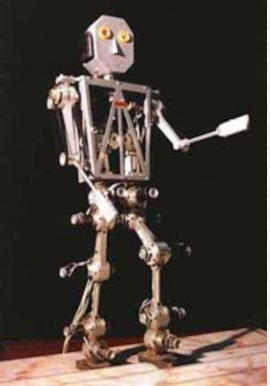
Around the year 2000, the Chinese-developed robot became a major topic of conversation on the Japanese internet.
At the time, Japan had Honda’s ASIMO. Compared with ASIMO walking smoothly on two legs, Xianxingzhe looked crude and had an unforgettable appearance. In Japan, the attention was mostly ridicule.
People altered its image, made parodies, and turned it into an internet meme.
I was one of the people laughing.
From Japan’s perspective at the time, the technological gap seemed that large.
Japan had world-class automakers, industrial robots, precision machinery, and even ASIMO walking on two legs.
Then we saw a Chinese humanoid robot and laughed: “So this is what Chinese robotics looks like?”
Nearly a quarter of a century has passed since then.
Today, when I watch a program about the future of physical AI, China’s cost competitiveness and mass-production capacity in robot hardware are presented as a major threat. Japan, meanwhile, is considering how to compete by bringing Chinese bodies and American brains into real workplaces.
The positions have changed considerably.
In a technological race, it is dangerous to laugh at a competitor based only on the quality of what it can produce today.
Build even when the result is incomplete.
Keep building even when people laugh.
Improve it even when it does not sell.
Continue for 20 or 30 years.
Eventually, the people who laughed may find themselves wondering how they can possibly compete.
In Japan, even the robot’s name—Xianxingzhe, “the pioneer”—became part of the joke.
Looking back now, it is not quite so funny.
Which country was the real pioneer after all?